Contributors
Yosi Avron
Maria-Jose Cantero
Charles
Fefferman
George Hagedorn
Sergey
Khrushchev

In the early eighties, Murph Goldberger was the president of Caltech. Murph was a great fan of Barry since their Princeton days and concocted a scheme to try and lure Barry from Princeton to Caltech. The scheme started innocently enough by inviting Barry to spend a year in sunshine California as a Fairchild Scholar. Murph's plan indeed worked like charm and a year of leave turned out to be a permanent move.
Princeton, at the time, was the Mecca of mathematical physics. It probably had the largest math physics group. Caltech, at the time, and as far as mathematical physics was concerned, was like the rest of Saudi Arabia: a desert (with a lot of oil). As you probably know, Barry thrives in company. So he looked for someone to accompany him to the desert. After a lot of fruitless searching, Barry must have remembered that I had some practical experience living in a real desert and asked me to join him. The arrangement was curious. I must have been the only Princeton Assistant Professor who had his paycheck sent to California. And, I remember that the bank teller once asked me if I could swing such a trick for her. She preferred the Bahamas, however. Anyway, since I had no official standing at Caltech, I decided to decorate myself as the Fairbaby Scholar.
The Fairkid year we spent together was a remarkable year, for I had Barry almost all to myself. In Princeton, where I first met Barry as his postdoc, I would get as an appointment the walks to the parking lot, and occasionally a ride to Edison spending a pleasant Shabat with Barry and Martha. How much leisure we had in this Fairkid year is evidenced by the fact that, hold on to your chairs, Barry and I used to go swimming regularly at lunch time at the Caltech swimming pool!
Can you imagine how many papers did not get written because of my bad influence on Barry! Swimming at the Caltech pool was very good for me: Here was a place where I could beat Barry fair and square.
Barry, on the other hand, felt very guilty about this waste of time. To comfort himself he told me that the lost hours at the pool would be paid up by gained years in better health. Well, what could be more appropriate than to celebrate this wisdom twenty years later, at his 60th anniversary party.
Let me now tell you a story involving Ira Herbst and Barry. I was an overwhelmed Wigner fellow at Princeton, working with Ira and Barry and we were quite close. Ira came back startled from one job interview, I forgot where. The chairman had asked him if he ever wrote a wrong paper. Ira was shocked and said "Of course not!" The reaction of the chairman was unexpected. He said: "Then you do not write enough." Now, nobody could ever accuse Barry of not writing enough. But I take the credit for writing a wrong paper with Barry. Here is how this came to be: There was a lot of excitement in Caltech when Voyager first sent those spectacular pictures of the rings of Saturn. I had learnt that Saturn appears to have infinitely many rings from a math grad student at Caltech. Barry and I were working at the time on almost-periodic Schrödinger equations and were fascinated with fractal spectra. I knew about Hill lunar theory and Barry had just written a review of Arnold's book on Mechanics. This led us to make a theory where the near incommensuration of the periods of the moon of Saturn (and also involved the Sun) gave rise to rings with fractal structure. Peter Goldreich, the czar of planetary physics in Caltech, did not like the theory because it was linear stability. But Feynman did because it was simple. The theory could not account for the order of magnitude for the observed gaps and so turned out to be wrong.
Barry's time axis is divided into AC and BC: Before Caltech and After Caltech. In the BC era Barry had difficulties deciding if his heart lay with constructive field theory, statistical mechanics or quantum mechanics. In the AC period the die was cast in favor of quantum mechanics and spectral theory. Barry also contracted a chronic strain of PC flu.
Since I am an old-timer let me reminisce about the prehistoric BC era.
At Princeton there were the lunch time seminars and the Math-Phys seminars. In the lunch time seminar, Barry was the prima ballerina. (Can you imagine Barry on his tiptoes?) He would normally either tell a new result of his or a new result of someone else. With Dyson, Lieb and Wightman in the audience, most grad students and postdocs, were too terrified to expose their slowness if they were to ask an innocent question. Most of the time, nobody dared open his mouth. The notable exception was the fresh grad student from Harvard, Alan Sokal, who never had a fear of authority and was sufficiently smart and self-confident to argue with Barry.
The math phys seminars were a different business. There was an outside speaker most of the time. Wigner would usually show up and ask his typical Wignerian questions. Barry would sit in the audience and write a paper. From time to time he would look up from his notes and ask a question that would unsettle most speakers: Someone in the audience seemed to know more about what he was talking about than himself. Sometimes, at the end of the talk, Barry would go to the board and give his version of the proof, which was always slick.
Barry, you are now 60. Most of us probably do not enjoy being reminded about our advanced age, but I think that one of the nice things about you, Barry, is your optimism. You probably, enjoy being 60! I wish you fun with math and good health in the next sixty years.
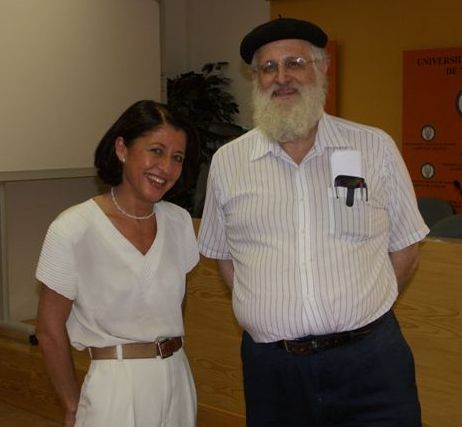
Barry with María-José Cantero (Madrid, June
2005)

Charles Fefferman
I have a cute Barry quote from a visit to Princeton in the late 80's or early 90's:
"To first approximation, the human brain is a harmonic oscillator."
He made this remark in private
conversation as we walked around the Princeton campus.

Below is an amusing little story that shows Barry's good sense of humor and how quickly he could think of a clever comment.
Barry had many graduate students at Princeton. Although he treated us well, he used to kid around about abusing us or treating us as some sort of subhumans. It was all in good fun, and I always found it amusing.
In November 1976, the night that Jimmy Carter was elected president, Barry invited some of us to to have dinner and watch the election results on the television at the Simons' house in Edison, New Jersey. Shortly after I arrived, I was hanging my coat up in the closet when Barry's daughter Rivka pointed at me and said, "Daddy, what's that man's name?" Without the slightest hesitation, Barry replied, "Rivka, that's not a man, that's a graduate student!"


Barry explains Szegö recursion
(taken in Snowbird, Utah, June 11, 2003)